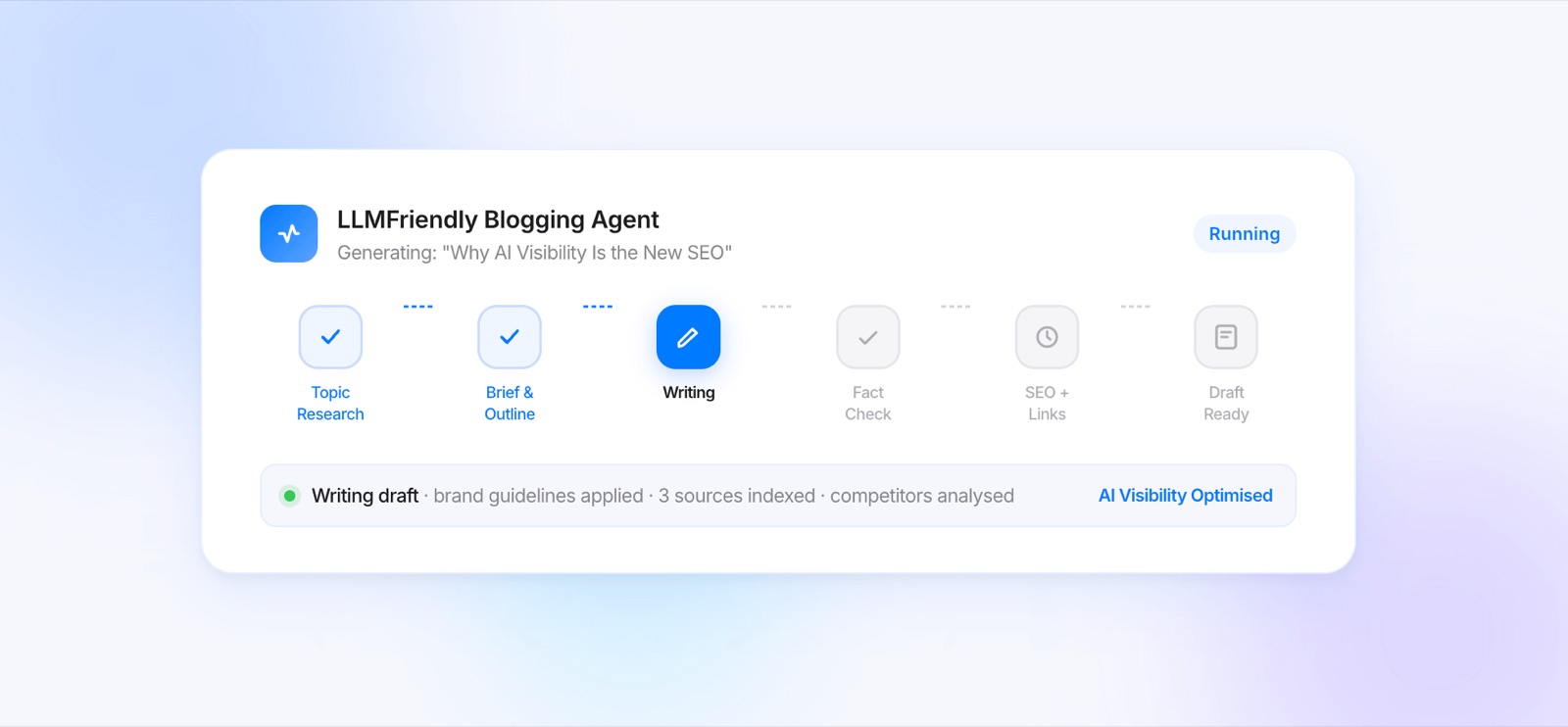
Think about what makes a great senior content writer valuable. It is not just that they write well. It is that they already know your business when they sit down to write. They understand what you sell, who you are selling to, how your brand sounds, and which pages on your site matter most. They do their research before they write a word. They weave in links to the right product pages naturally, not as an afterthought. And when they are done, the post reads like it came from someone who genuinely understands your company.
That is the bar most AI writing tools fall short of. They are fast, but they are writing blind. They do not know your brand, your products, or your existing content. Every post starts from zero, and it shows.
The LLMFriendly Blogging Agent was built around a different idea: what if the agent already knew everything a senior content writer would know before writing a single word?
It Starts With Understanding Your Brand
Before the agent writes anything, it reads your website. Not in a surface-level way, but deeply enough to extract how your brand communicates: the tone you use, the audience you write for, the products and services you offer, the language you avoid, and the positioning that makes you different from competitors.
This brand understanding is not a template you fill in manually. The agent derives it directly from your existing content and applies it to every post it generates. The result is writing that sounds like it came from someone who has been working with your brand for months, not a generic AI that has never heard of you.
It Knows What You Sell
A good content writer does not just write informative posts. They write posts that serve the business. They know which products are most important, which pages need traffic, and how to naturally guide a reader from an educational article toward something you actually offer.
The agent builds a catalog of your products and services from your site and uses it throughout the writing process. When it identifies an opportunity to reference something you offer, it does so in context, the way a knowledgeable writer would, not by forcing a sales pitch into an article that has no business containing one.
It Researches Before It Writes
A senior writer does not sit down and start typing from memory. They research the topic, check what competitors are saying, look at what their own company has already published, and find the angles that are worth covering. The agent follows the same process.
It crawls your existing content to understand what you have already covered and where the gaps are. It runs web searches to gather current information on the topic. It pulls in competitor data so the post is informed by what is already ranking. Only after that research is synthesized into a structured brief does writing begin.
It Handles SEO the Way a Good Writer Does
SEO done well is not about stuffing keywords into a document. It is about writing clearly on a topic, structuring the content so both readers and search engines can follow it, and connecting it to the rest of your site in a way that makes sense.
The agent handles all of this as part of the writing process, not as a separate optimisation pass. Internal links to relevant pages on your site are planned and placed in context, distinguishing between commercial pages that should drive conversions and informational content that builds authority. Meta titles and descriptions are written to earn clicks, not just to satisfy a keyword requirement. The post is structured with a clear hierarchy so it is easy to read and easy to parse. For a deeper look at what this means in practice, our guide to AI SEO covers the underlying principles.
It Writes for AI Visibility, Not Just Google
Search is no longer the only surface that matters. Users are asking ChatGPT, Gemini, and Perplexity for recommendations, and those systems are selecting which sources to surface based on how well-structured, authoritative, and topically coherent the content is. Most AI-generated blogs are invisible at this layer because they are written to fill a keyword brief, not to demonstrate genuine expertise on a subject.
The agent scores topic opportunities in part based on AI citation potential, identifying where your brand has gaps in how AI systems currently discuss your category. Posts are written with the depth and structure needed to be cited, not just indexed. To understand how your existing content performs across AI platforms today, our free AI Visibility Report gives you a baseline to work from.
What the Output Looks Like
You choose a topic from the agent's ranked suggestions, or bring your own. The agent researches, writes, fact-checks every claim against its sources, generates SEO metadata, plans and validates internal links, and saves a finished draft for your review. Nothing is published without your sign-off.
What you get is a post that reads like it was written by someone who knows your business, has done their homework on the topic, and understands how content needs to be structured to perform. The editing work that most teams spend significant time on after using generic AI tools is dramatically reduced because the brief was set properly before writing began.
Teams using the agent are seeing consistent output across posts in terms of brand alignment, structure, and depth, without the rewriting that tends to eat up the time savings that AI generation is supposed to provide. Detailed case studies and benchmarks are coming soon.
The Difference Context Makes
The gap between a good AI-generated blog post and a poor one almost always comes down to context. A writer who knows your brand, your products, your existing content, and your audience produces something fundamentally different from one who is given a topic and a blank page.
Most AI blogging tools give the model a blank page. The LLMFriendly Blogging Agent gives it everything a senior content writer would already know. That is the distinction that matters, and it is what determines whether the content you publish builds authority over time or simply adds to the volume of undifferentiated content that already exists. For more on how to measure whether your content is building the kind of authority that gets cited, see how to track brand visibility in ChatGPT and Gemini.
See What It Writes When It Knows Your Brand
The LLMFriendly Blogging Agent reads your website, understands what you sell, and writes posts that sound like your brand. Start by checking how your current content performs across AI platforms.
Get Your Free AI Visibility Report