For decades, search engine optimization followed one primary goal: ranking on the first page of Google. Marketers tracked keywords, optimized meta tags, and built backlinks to climb the search results pages. But the digital landscape has changed. Users now turn to Large Language Models like ChatGPT and Gemini to find answers, compare products, and make purchasing decisions. Appearing in a list of blue links is no longer the only metric for success.
The rise of AI SEO marks a new frontier for digital marketers. In traditional search, a user might browse several different websites. In contrast, an LLM often provides a single, synthesized response. If your brand is missing from that answer, you effectively do not exist to that user. This creates a visibility gap that traditional tools cannot measure. Relying on manual searches is inefficient and fails to capture how these models evolve over time.
To stay competitive, brands must move beyond basic keyword tracking and embrace automated AI competitor intelligence. Understanding how an AI perceives your brand compared to your rivals requires a systematic approach. You need to know which queries trigger competitor names and why the AI chooses them over you. This data forms the foundation of a modern visibility strategy, allowing you to reclaim your share of voice as AI-generated answers become a primary source of information.
Recent data shows a widening gap in AI mentions for high-intent queries. Many established brands remain invisible in AI conversations despite having strong traditional search rankings. Closing this gap requires a specialized brand monitoring tool designed for the nuances of LLM responses. By automating this process, SEO specialists gain the insights needed to influence AI outputs and ensure their brand remains a top recommendation.
Learn how to track your brand across AI platforms and why an AI SEO guide is essential for modern marketers.
Step-by-Step: Configuring Your ChatGPT Brand Mention Tracker
Setting up a ChatGPT brand mention tracker is the first practical step toward mastering your AI visibility. Within the LLMFriendly dashboard, the process begins by identifying the core queries that drive your business. These are typically high-intent questions where a user seeks a specific solution, such as "What is the best project management tool for small teams?" or "Which CRM has the best automation features?"
Once you identify these queries, input them into the tracker to monitor how ChatGPT responds over time. The system periodically prompts the model with these questions and records every instance where your brand or a competitor is mentioned. This provides a clear picture of your share of voice within the ChatGPT ecosystem. You can see if you are being recommended as a primary choice, mentioned as an alternative, or omitted entirely from the conversation.
To maximize the tracker, define a diverse set of queries. Do not just track your brand name. Instead, focus on category-level searches and problem-solving queries. This allows you to see which competitors dominate the thought leadership space in the eyes of the AI. By tracking these interactions, you can identify patterns in how ChatGPT categorizes your brand and whether it associates you with the right features and benefits.
The technical configuration also allows you to set up alerts for significant changes in visibility. If a competitor sees a sudden spike in mentions for a key query, the tracker will highlight the shift. This real-time data is crucial for SEO specialists who need to react quickly to changes in AI behavior. Using LLMFriendly to automate this monitoring moves your strategy away from anecdotal evidence toward data-driven AI optimization.
Discover how to track your brand with precision across AI models.
Analyzing the Gemini Brand Mention Tracker to Outpace Competitors
While ChatGPT is a major player, Google's Gemini presents a different set of challenges and opportunities. Because Gemini is deeply integrated into the Google Search ecosystem, its responses often draw from a different set of live web data. Using a Gemini brand mention tracker allows you to see how Google's own AI perceives your brand. This is particularly important because Gemini's outputs can influence the broader Search Generative Experience.
When you analyze data from the Gemini tracker, look for discrepancies between different models. For example, you might find that ChatGPT recommends your brand for technical queries while Gemini favors a competitor for the same search. These platform-specific differences point to gaps in your content strategy. Gemini might prioritize information from specific news sources or Google Business profiles that ChatGPT does not weight as heavily.
Effective AI competitor intelligence involves comparing these metrics to identify where rivals are winning. If a competitor has a higher share of voice on Gemini, investigate the types of content they publish. Are they more active on platforms that Google's AI tends to crawl frequently? By understanding these model-specific preferences, you can tailor your content distribution to improve visibility across all major LLMs rather than focusing on just one.
Furthermore, tracking Gemini mentions helps you understand how your brand reputation is being synthesized by Google's AI. Gemini often provides citations and links to sources, which offers a direct path to understanding its reasoning. By monitoring these mentions consistently, you can ensure that the information Gemini provides about your brand is accurate and highlights your unique selling propositions. This level of detail is essential for any modern brand monitoring tool strategy.
For a deeper dive, explore our comprehensive AI SEO guide.
Uncovering the Sources: Using Citations Monitor for AI Competitor Intelligence
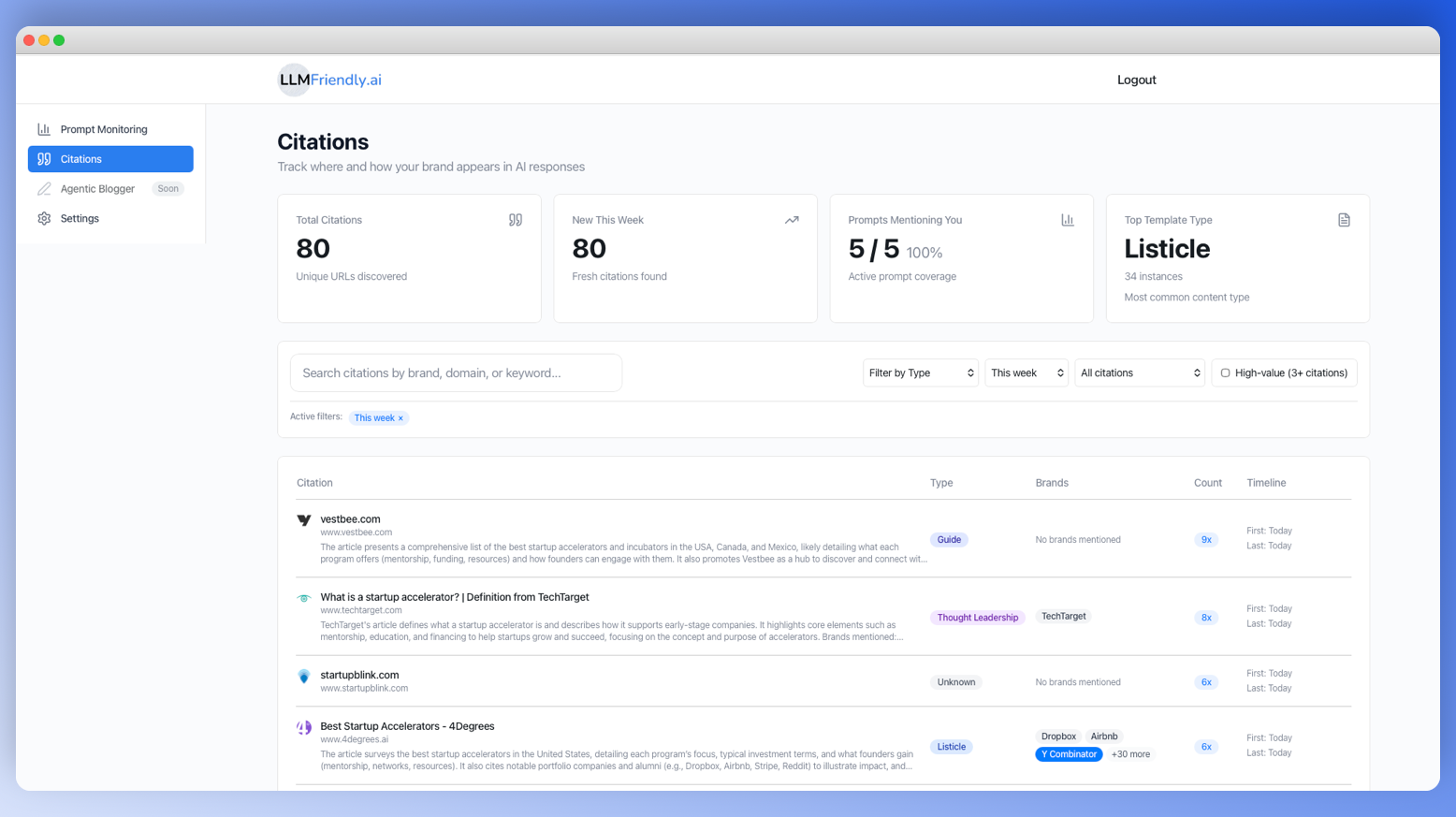
One of the most powerful features of a comprehensive brand monitoring tool is the ability to see exactly where an AI gets its information. LLMs do not create facts out of thin air. They rely on massive datasets and live web browsing to find current information. The Citations Monitor allows you to reverse-engineer the authority of your competitors by identifying the specific websites, articles, and forums that LLMs use as sources for their mentions.
When an AI mentions a competitor, the Citations Monitor tracks the underlying sources that informed that response. This is a goldmine for AI competitor intelligence. If you notice that a particular industry blog or review site is frequently cited when ChatGPT recommends a rival, you know exactly where you need to build a presence. This allows you to move beyond guessing which backlinks matter and focus on the specific sources that influence AI logic.
Targeting these citation sources is a highly effective way to improve your AI SEO. By getting your brand featured on the same platforms that the AI already trusts, you increase the probability that the model will include you in future responses. This might involve guest posting, securing product reviews, or participating in relevant community discussions. The goal is to insert your brand into the knowledge graph that the AI uses to generate its answers.
This strategy also helps you identify authority gaps. You might find that while you have many backlinks, they are not from the sources the AI considers authoritative for your specific niche. By using the data from LLMFriendly, you can refine your PR and content marketing efforts to target the high-impact sources that actually move the needle in AI visibility. This proactive approach ensures that your brand is part of the foundational data the AI relies on.
Learn how the Citations Monitor transforms competitor intelligence — and track visibility across all major LLMs.
How to Use AI SEO Data to Dominate LLM Responses
Once you have gathered data from your ChatGPT brand mention tracker and other tools, the next step is to act. Raw data is only valuable if it leads to actionable content updates. If the data shows you are invisible for high-intent queries, you must analyze the mention gap. This involves looking at the specific language and context the AI uses when it does mention competitors and finding ways to align your content with those patterns.
Optimizing for AI SEO often requires a shift in how you write content. LLMs favor clear, structured, and factual information. If your website uses overly flowery language or lacks direct answers to common questions, an AI may struggle to extract the information it needs to recommend you. Use the insights from your trackers to identify the specific questions users are asking and create content that provides the most comprehensive, easy-to-parse answer available.
Closing the mention gap also means addressing the specific attributes the AI associates with your competitors. If an AI describes a competitor as the most affordable or easiest to use, and those are areas where you also excel, you need to ensure your content reinforces those claims. Update your landing pages, FAQ sections, and blog posts to explicitly state these benefits in a way that an AI can easily identify and synthesize into a response.
Finally, use your brand monitoring tool to track the impact of these changes. AI models do not update their internal knowledge instantly, but their web browsing capabilities allow them to see new content relatively quickly. By monitoring your share of voice after implementing content updates, you can see which strategies are working and which need further refinement. This iterative process is the key to dominating LLM responses and ensuring your brand stays top of mind.
Master this with our proven method: how to track your brand and turn insights into action.
Scaling Your Strategy with a Dedicated AI Brand Monitoring Tool
As the influence of AI continues to grow, manual checks and ad hoc monitoring will no longer suffice. Scaling your strategy requires a continuous, automated system that provides a long-term view of your AI visibility. A dedicated brand monitoring tool allows you to track hundreds of queries across multiple models simultaneously, providing the bird's-eye view necessary for enterprise-level SEO. This consistency is what allows a brand to maintain its lead or catch up to established rivals.
The business value of this approach is clear. By reclaiming your brand's presence in AI-generated content, you are capturing users at the very moment they are seeking recommendations. This leads to higher-quality traffic and better conversion rates, as the user has already received a soft endorsement from the AI. Investing in AI competitor intelligence today ensures that you are not left behind as the search landscape continues its rapid evolution toward a conversational, AI-first model.
For SEO specialists, the goal is to move from being reactive to being proactive. Instead of wondering why your traffic is dipping, you can use data to show exactly where your AI visibility stands and what steps are being taken to improve it. This level of insight is invaluable for reporting and for securing the resources needed to execute a modern digital marketing strategy. The tools are available to help you navigate this change and ensure your brand remains a dominant force in the age of AI.
To scale effectively, build your strategy on a solid foundation — start with our complete AI SEO guide.
Take Control of Your Brand's AI Visibility
If you are ready to take control of your brand's future in the world of LLMs, it is time to start tracking. Discover how our specialized trackers can help you outpace the competition — don't let your brand become invisible in the conversations that matter most.
Start Tracking for Free